Live small-group online course · Aug 17–27, 2026 · 12 seats
Your student starts AP Calculus in a few weeks. Four live evenings — Aug 17–27 — so they walk in ready, before the course even starts.
Here’s the pattern every AP Calc teacher knows: the kid who got an A in precalc, whose homework looks fine in September — and whose grade craters on the first test, before anyone knew there was a problem. AP Calc Head Start is four live 90-minute sessions with a teacher who taught AP Calculus, in the two weeks before school starts, aimed at exactly the gaps that cause that first-test surprise. Twelve students, every one of them working problems live.
Reserve a founding seat — $49 refundable depositFully refundable any time before the first session. You’re reserving one of 12 seats, not paying $397 today.
Not ready to reserve? Book a free 20-minute readiness call with the teacher →The worry, in parents’ own words
If your student is signed up for AP Calculus AB or BC this fall, you may recognize the worry. It usually isn’t “my kid is bad at math.” It’s quieter than that — and it tends to show up after the first test, when the grade has already moved.
Here is how parents describe the math blindside — from precalc straight through AP Calc — in their own words, on public parent forums. (These are not our clients — this is what it sounds like from the kitchen table when the grade moves before anyone saw it coming.)
“My kid had problems with AP Calc AB at the beginning of this year too.” — parent, College Confidential (AP Calculus AB thread)
“I could be your parent. My kid has only struggled in AP Calc AB.” — parent, same College Confidential thread
“He gets 100% grades on all homework. All of it. … And then he gets to the tests and tanks.” — parent of a precalc student, College Confidential Parents Forum
“he never comes out of class understanding the material, and has to re-study it at home” — parent, College Confidential Parents Forum
“I don’t remember enough pre-calculus to be helpful.” — parent of a precalc student, College Confidential Parents Forum
And the sentence underneath all of it — a mother relaying her son’s own words (he was in precalc; the pattern doesn’t wait for calculus):
“I just I don’t know what I’m doing wrong.” — student, as told by his parent on the College Confidential Parents Forum
Three things make this particular class hard on families:
Homework grades stay fine while understanding quietly slips, so the first real signal a parent gets is a posted test grade. By then it’s October and the course has moved on.
Even with a good teacher — and most AP Calc teachers are good — the course covers a year of college calculus in a school year. There is no built-in week for patching precalc gaps. Nobody slows down.
Most of us don’t remember enough precalculus to help, and most teenagers won’t take math help from a parent anyway. Wanting to help and having no way to is its own kind of stress.
None of that means your student can’t do this. It means the on-ramp matters.
Why A students still hit a wall
When I taught AP Calculus, the students who struggled in the first month almost never struggled with the new ideas — limits, derivatives — in isolation. They struggled because the course assumes, silently and from day one, four things are already automatic:
A student can earn an A in precalc with those four at “did it last spring, mostly remember it” strength. AP Calc needs them at reflex strength — and the gap between those two doesn’t show up on homework, where there’s time and a worked example nearby. It shows up on the first test. One parent on a public forum put it exactly right:
“Math really is based on building a good foundation and there are places along the way where pieces are missing” — parent, College Confidential Parents Forum
Why August? Because it’s the only time this is cheap to fix. In August, closing these gaps is four evenings and some practice sets — there’s no new material piling up on top, no grade to rescue, no confidence to rebuild. In October, the same gaps cost tutoring money, test grades, and a student who has started saying “I’m just not a math person.” Same fix. Very different price.
To be clear about what this is not: Head Start is not a compressed calculus course, and I’d talk you out of one — math taught at 3–4× speed doesn’t stick. This is the on-ramp: the four assumed skills, plus a genuine head start on limits, the first unit of the actual AP course. Your student’s school year still teaches the course. We make sure they start it from ahead.
The program
AP Calc Head Start is a live, small-group online course for rising AP Calculus AB and BC students, taught by Volak S., who taught AP Calculus.
| Session | Date | Time |
|---|---|---|
| Session 1 — Algebra AP Calc assumes you have | Mon, Aug 17 | 7:00–8:30 pm ET |
| Session 2 — Trig without the panic | Thu, Aug 20 | 7:00–8:30 pm ET |
| Session 3 — Exponentials, logs & reading functions | Mon, Aug 24 | 7:00–8:30 pm ET |
| Session 4 — Limits: walk in knowing the first unit | Thu, Aug 27 | 7:00–8:30 pm ET |
Live on Zoom. Done before (or during) the first week of school for most districts.
The price: $397 for a founding seat.
Reserve it today with a $49 deposit — fully refundable any time before the first session. The balance ($348) is collected about a week before Session 1. If the cohort doesn’t run, every deposit is refunded automatically.
12 seats total, enforced at checkout. Fully refundable before Session 1 — one email, no questions.
Who’s teaching
I’m Volak S. I’ve taught AP Calculus, spent six-plus years tutoring Calculus I and II at a college math lab, and seven more teaching precalculus and trigonometry one-on-one.
I taught AP Calculus, and every year the same thing happened: bright students — A’s in precalc, good habits, no drama — hit the first test in late September and came out shaken. Not because the calculus was beyond them, but because the course assumes four precalc skills are automatic, and nobody had made them automatic. By the time the gap was visible on a report card, we were three units in and patching on the run.
Head Start is the fix I could never give them inside the school year: four evenings before the course starts, small enough that nobody hides, focused on exactly those four skills plus the first real topic of the course. I also built the practice platform your student will use between sessions — the same one that generates their assignments and the weekly report you’ll get — so when I say I’ll know what your student practiced and where they’re stuck, that’s literal.
I won’t promise you an AP score from a two-week August course — no honest teacher would. What I can promise is that your student walks into the first week of AP Calc with the gaps closed and the first topic already familiar, and that you’ll see exactly what they worked on every week.
From students I’ve taught
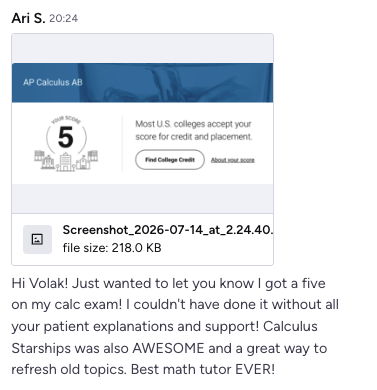
This is the cohort’s first run, so it has no reviews yet — and I won’t pretend otherwise. What I can show you is what students and parents have said about learning calculus with me one-on-one, shared with their permission.
On the AP exam
And across all of calculus
And the doors it opens
These are real students I taught one-on-one, before Head Start existed — shared with their permission. Their results are their own; no course can promise a score, and I don’t. What I bring to this cohort is the same teaching that’s behind every screenshot above.
How it works
Your student completes a short readiness check online (about 20 minutes, covering algebra, trig, logs/exponentials, and functions). I read every one before we start, so Session 1 is aimed at this cohort, not a generic syllabus.
Session 1 (Mon Aug 17): the algebra. Function notation and composition, factoring with fractional and negative exponents (the form derivatives actually arrive in), complex fractions, solving cleanly. Session 2 (Thu Aug 20): the trig. The unit circle rebuilt from two triangles — derived, not memorized — radians as the default language, the handful of identities that actually appear, solving trig equations.
Session 3 (Mon Aug 24): exponentials and logs. e and ln as one system, solving exponential and log equations, plus reading functions the way calculus does — where they increase, decrease, and change. Session 4 (Thu Aug 27): limits. The first unit of the actual AP course: what a limit is in plain language, reading limits from graphs, computing them, continuity. Your student walks into week one of school already knowing the opening topic. Session 4 ends with the exit readiness check — same skills as the intake, so the final report shows the before-and-after.
I teach an idea for ten minutes, I work one problem, then your student works one live while I watch and correct in real time — three blocks of that per session. Nobody hides in this class; with 12 students, everyone is called on, every session.
A practice assignment on the platform, due before the next session. I see completion and accuracy on my dashboard — students don’t get to quietly skip it, and you don’t have to nag, because I follow up.
Your one-page parent progress report — what we covered, what your student did, where they’re solid, where they’re still shaky.
Recordings and platform access stay open through the AP exam in May, including a maintenance practice set for the first weeks of school.
The guarantee — plainly
Your $49 deposit is fully refundable any time before the first session — one email, no questions asked. If the cohort doesn’t fill and doesn’t run, every deposit is refunded automatically.
Come to Session 1. If you and your student don’t think it’s worth it, tell me and I’ll refund every dollar — and your student keeps all the materials from that session.
That’s the whole guarantee. No fine print, no forms. You’re deciding after you’ve seen the actual teaching, not before.
Reserve a founding seat — $49 refundable depositNot sure yet?
If you’re not sure Head Start is the right fit — or not sure your student even needs it — book a free 20-minute AP Calculus readiness call with me. We’ll talk through which course your student is heading into (AB or BC), walk a short readiness check together, and I’ll tell you honestly where they stand.
You’ll leave the call with one of three answers, and I’ll say it plainly: your student is ready and doesn’t need me (I’ll tell you what to review the week before school); there are specific gaps and the cohort covers them; or the gaps need more than two weeks, and here’s what I’d do instead. It’s a teacher’s read on your kid’s readiness, with no hard sell — if the cohort is the fit, I’ll tell you what it costs once and leave the decision with you. Parents book it; students are welcome on the call.
Book the free 20-minute readiness callQuestions parents ask
A tutor is the honest comparison, so here’s the honest math. A local or online tutor runs $25–40/hour; an hour a week from September through December is roughly $400–650 for the semester — and what you get for it is unstructured: no set curriculum, no data, and a quality lottery. One parent on the forums describes a tutor who “didn’t mesh at all” — and in those same threads, the tutor is almost always hired after the first bad grade, and no parent describes getting a plan or a progress report from one. Head Start is $397 for six live teaching hours — about $66 per live hour, so no, it’s not the cheapest rate per hour. What that buys instead of loose hours: a teacher who taught AP Calculus, a defined four-session curriculum aimed at the exact gaps that sink first tests, checked practice between sessions, a before-and-after readiness measurement, a written parent report every week, and recordings plus platform practice through May. The deeper difference is timing: tutoring is almost always bought reactively, after the grade slides. This is the same intervention, bought before the damage, when it’s cheapest.
Because the app isn’t the program — the live class is. Your student has four scheduled evenings with a teacher who knows their name, calls on them, and watches them work problems in real time. The platform is the homework between sessions, and it’s checked: I see on my dashboard exactly who did the assignment and how it went, I follow up with the student, and it shows up in your weekly report. The schedule and the teacher are the compliance mechanism. Self-paced programs fail teenagers because nobody is expecting anything on Thursday. Here, somebody is.
Yes, both. AB and BC start from the same place: the same four precalc skills, and limits as the first unit of either course. Head Start covers that shared on-ramp. BC students arguably need it most — BC moves faster, so a wobble in the foundation costs more, sooner. On the readiness call I’ll also give you a straight opinion on the AB-vs-BC choice for your particular kid, if that’s still open — the right answer is mastery, not the label on the transcript.
Head Start is for rising AP Calculus students — meaning they’ve completed precalculus and are enrolled in AP Calc AB or BC this fall. That’s the only prerequisite. As for whether they need it: an A in precalc doesn’t settle it either way, which is the whole problem — the gaps that matter don’t show on precalc report cards. That’s what the readiness check before Session 1 is for, and if you’d rather know before putting any money down, that’s exactly what the free 20-minute call is for. If your student is genuinely ready, I’ll tell you that — and the $397 stays in your pocket.
Every session is recorded, and the recording is emailed within 24 hours — a student who misses one watches the replay, does the same practice assignment, and I check their work on the dashboard like everyone else’s. Missing one session is fine; the structure holds. I wouldn’t enroll knowing you’ll miss three — the live problem-working is the point. (And if I ever have to miss a session, it gets rescheduled within the same week — never replaced with a recording.)
Three layers, in plain language. (1) The $49 deposit is fully refundable any time before Session 1 — one email, no questions asked. (2) If the cohort doesn’t fill and doesn’t run, every deposit is refunded automatically, without you asking. (3) After Session 1, the first-session guarantee: come to Session 1 — if you and your student don’t think it’s worth it, tell me and I’ll refund every dollar, and your student keeps all the materials from that session. The balance ($348) isn’t collected until about a week before Session 1.
Because of how the first month of AP Calc works. The gaps this course fixes don’t show up on homework — they show up on the first test, usually late September or early October. If you wait to see how it goes, the signal you’re waiting for is the bad grade, and by then your student is patching foundations while new material keeps arriving, with a grade to rescue and confidence to rebuild. In August the same fix is four evenings, no new material piling on top, nothing to undo. And to say it directly: this is not a compressed summer calculus course — I wouldn’t recommend one. It’s six live hours across two weeks, covering the on-ramp only.
They do, and the schedule is built so they still get one. Here is the total time cost, plainly: six live hours across two weeks — four 90-minute sessions on Monday and Thursday evenings (7:00–8:30 pm ET) — plus a practice assignment between sessions. No daytime commitments, no weekends, and it’s finished Aug 27, before the first bell for most districts. The rest of August stays theirs. And rest and readiness aren’t actually competing here: six evening hours now is what lets the school year start calm, instead of starting with a grade to rescue.
Twelve students, and that’s a hard cap — it’s enforced by the checkout itself, so when the page says 12 seats, that’s mechanical fact, not marketing. Twelve is the number where I can still have every student work problems live every session and know exactly where each one stands. This isn’t a webinar your kid watches; it’s a class your kid is in.
I do — Volak S. Every session, live. I taught AP Calculus, and I built the practice platform and the instructor dashboard your weekly report comes from. There’s no rotating staff of tutors and no pre-recorded lectures standing in for teaching: the teacher on this page is the teacher on the Zoom call, all four sessions. If I ever had to miss one, it would be rescheduled within the week, not handed off.
Aug 17–27, 2026
AP Calc Head Start runs Aug 17–27 — four live 90-minute sessions, practice between them, a weekly report to you, and a student who walks into AP Calculus already knowing the first unit.
$397 founding seat. Reserve it with a $49 deposit — fully refundable any time before Session 1.
Reserve a founding seat — $49 refundable depositRather talk it through first? Book a free 20-minute readiness call with the teacher →